Cookbook Medicine: Beyond One Size Fits All
By Rob Platou
The Hidden Cost of "Try and Check" Medicine
The impact of trial-and-error prescribing on our healthcare system is significant. When the stakes couldn't be higher, the numbers tell a frustrating story:
- 48% of drug prescriptions are either the wrong drug or the wrong dosage.[1]
- 75% of cancer drugs are also the wrong drug and dosage.[2]
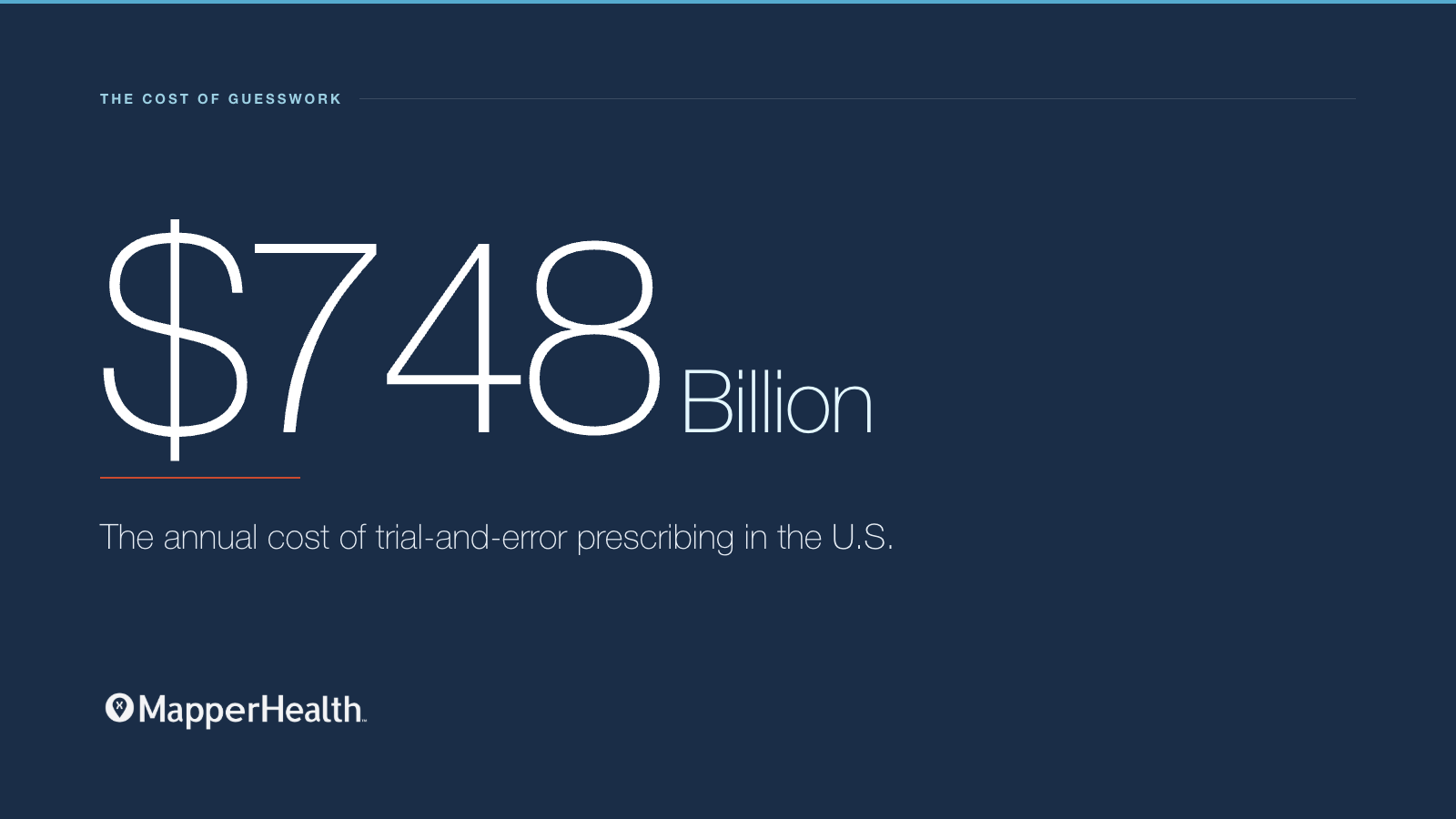
- These issues compound to over $748 billion in cost of harm to the U.S. healthcare system.[3]
Over the last decade, I've worked in multiple healthcare organizations, including the largest public healthcare system in the U.S. and the most renowned nonprofit health system in the world. I've seen firsthand the push to adopt clinical practice guidelines to standardize the practice of medicine.
While these standardized protocols offer maximum benefit to the majority of patients—improving safety, quality control, and consistency—they have some serious drawbacks.
Some physicians I've met negatively refer to this as "Cookbook Medicine." If a clinical practice guideline is developed for 90% of the population, it will not work optimally, or at all, for the remaining 10% of people. When you combine all these protocols, it virtually guarantees that there is a protocol that will not work for you. It’s a question of whether you are unlucky enough to have a condition that requires that protocol. And, without genomics informing decisions, I don’t like our odds.
Care becomes highly algorithmic: physicians are often boxed into protocols like, "First prescribe medication A, and if it doesn't work, then Medication B, then C, and then D." This "Try and Check" method is a painful and costly process for patients who don't fit the mold.
The Escalation Problem
Doctors are doing their best to work within standard formularies, but the current system forces them into a difficult corner. Let's look at rheumatology as an example. A doctor typically starts a patient on a frontline therapy like methotrexate. The problem is that these initial treatments fail frequently.
"We practice rheumatology without any help. We are told by the insurer what to prescribe to the patient. After they fail methotrexate, it's a TNF inhibitor, almost always Humira. And that's not OK."
— Dr. Vibeke Strand, Stanford Rheumatologist[4]
The data backs up her frustration. Dr. Strand co-authored a study showing just how common this is: 66% of rheumatoid arthritis patients have an inadequate response to their initial targeted therapy.[5] When that first drug fails, the toll is heavy:
- Medical costs jump by over $3,200 per patient.
- Hospital admissions nearly double.
- Patients miss an average of 22 days of work.
Faced with a failing frontline drug, doctors are hesitant to guess on a second or third frontline option. So, they escalate quickly to an expensive biologic or biosimilar. Biologics have a higher probability of success, but they still aren’t guaranteed to work for everyone.
This is where pharmacogenomics (PGx) provides a clear path forward. If a physician has a patient's genetic profile, they don't have to abandon the frontline menu after one failure. They either get the first one right, or can confidently choose a different frontline therapy that they know will work, avoiding the premature jump to a high-cost biologic. And if the patient truly needs a biologic, the doctor can use precision data to ensure they pick the exact one that will be effective.
By guiding physicians to the right medication on the first try, MapperHealth helps members get better faster while directly reducing overall drug spend for plan sponsors.
Beyond One Size Fits All
I joined MapperHealth to provide a missing link that makes our healthcare system more effective and efficient. This is one of those rare examples in healthcare in which a solution improves patient care, while reducing hard tangible costs.
Every individual is unique. The human genome can provide significant insight into an individual's biology, what their inherent risks are for developing disease, and how they would react to different treatments and medications.
At MapperHealth, by testing an individual's DNA, we are able to determine which medications would work best for that individual's unique biology. This gives physicians a powerful tool to identify the best medication for an individual on the first try. We are also able to help identify individuals at high risk for certain diseases 8.9-10.8 years earlier than standard screening guidelines,[6] giving patients and their physicians precious time to put in place low-cost interventions to save lives.
MapperHealth's genomic services, now available for plan sponsors, replace the guesswork of cookbook medicine. This approach leads to more effectively managed, personalized healthcare that reduces both drug and medical spend. It equips today's physicians with a tool that fills the gap in our healthcare system and allows for truly individualized medicine.
Sources & Citations
- Spear, B.B., M. Heath-Chiozzi, and J. Huff, Clinical application of pharmacogenetics. Trends Mol Med, 2001. 7(5): p. 201-4.
- Spear, B.B., M. Heath-Chiozzi, and J. Huff, Clinical application of pharmacogenetics. Trends Mol Med, 2001. 7(5): p. 201-4.
- Watanabe, J.H., T. McInnis, and J.D. Hirsch, Cost of Prescription Drug-Related Morbidity and Mortality. Ann Pharmacother, 2018. 52(9): p. 829-837.
- National Public Radio (NPR), "Rheumatoid arthritis precision medicine Humira", Dec 20, 2023.
- Strand V, Tundia N, Song Y, Macaulay D, Fuldeore M. Economic Burden of Patients with Inadequate Response to Targeted Immunomodulators for Rheumatoid Arthritis. Journal of Managed Care & Specialty Pharmacy. 2018;24(4):344-352.
- Chuong M, et al, Preventing premature deaths through polygenic risk scores. Nat Commun. 2026 Jan 21;17(1):1379.